
Trays (Sieve, Valve, Bubble cap) : “Tray types in Distillation: Efficiency and Pressure Drop”
Distillation columns form the most important equipment of many chemical and petrochemical plants, enabling separation of mixtures based on volatility differences. Within these columns, trays or plates act as vital contact devices where vapour and liquid phases interact to achieve separation. The choice of tray significantly influences the performance, efficiency, and energy consumption of a distillation column.
Among the most common types of trays are sieve trays, valve trays, and bubble cap trays. Each has its own structural design, operating mechanism, and suitability based on process requirements. In this blog, we’ll delve into how these trays differ, especially in terms of efficiency and pressure drop, which are two of the most crucial performance metrics in tray design.
Understanding Efficiency and Pressure Drop
Before comparing tray types, it’s important to understand what efficiency and pressure drop mean in the context of tray columns.
Tray efficiency refers to the effectiveness of vapor-liquid contact on a tray. It determines how well a tray performs in separating the more volatile components from the less volatile ones. Higher tray efficiency translates to fewer stages required for a given separation, thereby reducing the height of the column.
On the other hand, pressure drop is the loss of pressure as vapor passes through a tray. It’s influenced by the resistance posed by tray internals and the height of liquid held on the tray. Excessive pressure drop can affect vapor flow distribution and energy efficiency, especially in vacuum operations or columns handling heat-sensitive materials.
Sieve Trays
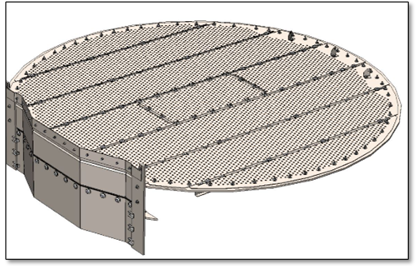
Sieve trays are the simplest and most economical type of tray used in distillation columns. These trays consist of flat plates with uniformly punched holes through which vapor rises and contacts the liquid that flows across the tray. There are no moving parts, making them easy to fabricate and maintain.
In terms of efficiency, sieve trays offer moderate performance. The vapor rising through the holes creates turbulence, which enhances mixing and mass transfer. However, they are more prone to weeping at low vapor flow rates. Weeping occurs when the vapor flow isn’t sufficient to hold the liquid on the tray, causing it to leak through the holes without proper contact.
Pressure drop in sieve trays is generally low due to the absence of mechanical obstructions. This makes them suitable for operations where pressure constraints are tight, or where the energy cost of compression is a concern.
Valve Trays
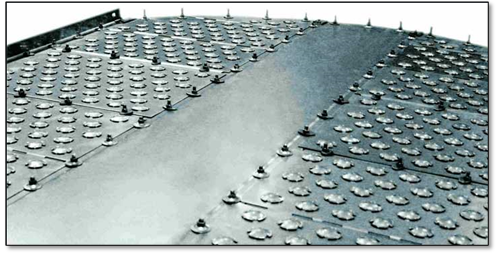
Valve trays introduce a level of control and flexibility not found in sieve trays. They consist of perforations covered by liftable or fixed valves. These valves respond dynamically to vapor flow, opening wider at higher flows and closing at lower flows. This self-adjusting feature allows better control over vapor distribution across the tray surface.
Efficiency of valve trays is typically higher than sieve trays. The valves help distribute vapor more uniformly and reduce weeping, leading to better contact with the liquid. Additionally, they perform well over a broader operating range, offering a higher turndown ratio, the ability to function effectively across varying flow rates.
The pressure drop across valve trays is moderate. Although the valves add some resistance to vapor flow, they also prevent problems like vapor channeling and maldistribution, which can harm column performance.
These trays strike a good balance between cost, efficiency, and operational flexibility, making them a popular choice in many industrial applications.
Bubble Cap Trays
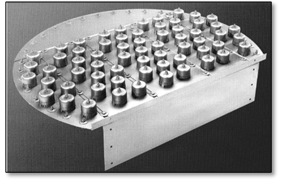
Bubble cap trays are among the oldest tray designs but are still relevant in specialized operations. Each tray contains several risers (or chimneys), each covered by a bubble cap. Vapor rises through the riser, hits the cap, and is redirected through slots into the liquid pool on the tray. This design forces vapor to bubble through the liquid, ensuring consistent contact regardless of vapor load.
The efficiency of bubble cap trays is high, especially at low vapor rates where other tray types may struggle. Since vapor is directed through the liquid, there is no chance for weeping, making them highly reliable in low-load conditions and start-stop operations.
However, this efficiency comes at the cost of high pressure drop. The complex vapor flow path adds resistance, and the liquid hold-up on the tray is higher. These trays are also more expensive to manufacture and harder to clean, making them less suitable for dirty or fouling services.
Despite these drawbacks, bubble cap trays are preferred in vacuum distillation, batch distillation, and processes involving corrosive fluids or feed variation.
Comparative Summary
To provide a clearer picture, here’s a summarized comparison of the three tray types:
| Feature | Sieve Tray | Valve Tray | Bubble Cap Tray |
| Efficiency | Moderate | High | Very High |
| Pressure Drop | Low | Medium | High |
| Turndown Ratio | 2:1 to 3:1 | 4:1 to 10:1 | 10:1 or higher |
| Weeping Resistance | Low | Medium | Very High |
| Maintenance | Low | Moderate | High |
| Capital Cost | Low | Medium | High |
| Suitability | Clean,steady flows | Variable loads | Low load, vacuum, corrosive systems |
Conclusion
The choice of tray type in a distillation column is not just a matter of preference—it has profound implications for process efficiency, energy usage, and operational stability.
Sieve trays offer simplicity and low cost but may underperform at low vapor rates. Valve trays provide a versatile solution with higher efficiency and better control, ideal for fluctuating conditions. Meanwhile, bubble cap trays, though costly, guarantee superior contact and are indispensable in operations with low or highly variable vapor flows.
Engineers must weigh these trade-offs carefully based on feed properties, operating conditions, and process economics. With the right tray selection, a distillation column can achieve both high efficiency and long-term reliability.
The choice between sieve, valve, and bubble cap trays is a strategic one.
- Are your flow rates steady or dynamic?
- Is energy efficiency a priority?
- Are you dealing with corrosive or heat-sensitive materials?
- Sieve trays are budget-friendly and great for stable flows.
- Valve trays offer a solid middle ground with performance flexibility.
- Bubble cap trays dominate in reliability for complex or sensitive operations.
With the right selection, you don’t just build a better column—you unlock greater efficiency, reliability and energy efficient.