
Energy Optimization Through Heat Integration in Aspen Plus
Energy efficiency and utility cost reduction have become critical imperatives in modern process industries. Rising fuel and electricity prices, tightening emissions regulations, and ambitious corporate decarbonization targets are forcing refineries and chemical plants to rethink how they use heat and utilities. Heat integration—the systematic recovery and reuse of thermal energy within a process—offers one of the most economically attractive pathways to achieve these goals, often delivering payback periods under two years.
What Is Heat Integration and Why It Matters
Heat integration applies thermodynamic principles to match hot process streams (those needing cooling) with cold streams (those requiring heating), reducing reliance on external utilities like steam, fired heaters, and cooling water. This reduces the load on furnaces, boilers, and cooling systems, directly lowering operating costs and indirect CO₂ emissions. In highly energy-intensive units such as distillation trains, crude distillation units, and petrochemical processes, heat integration can unlock double-digit percentage reductions in energy use.
Aspen Plus integrates these concepts through its Energy Analysis tools and connection to Aspen Energy Analyzer, enabling engineers to translate pinch theory into actionable exchanger networks. The software automatically identifies process hot and cold streams, constructs composite and grand composite curves, calculates minimum utility targets, and proposes economically viable HEN configurations.
Pinch Analysis: The Foundation of Energy Optimization
Pinch analysis is the core methodology behind modern heat integration. It uses thermodynamics and enthalpy balances to identify the theoretical minimum heating and cooling requirements for a process. The key concepts are:
- Hot streams: Streams that must be cooled (e.g., reactor effluent, column overhead vapours, hot product streams).
- Cold streams: Streams that must be heated (e.g., feed streams, reflux, makeup streams).
- Composite curves: Temperature–enthalpy plots of all hot and cold streams that show where heat can be feasibly recovered.
- Pinch point: The location where the temperature difference between hot and cold composite curves is at its minimum (∆Tmin).
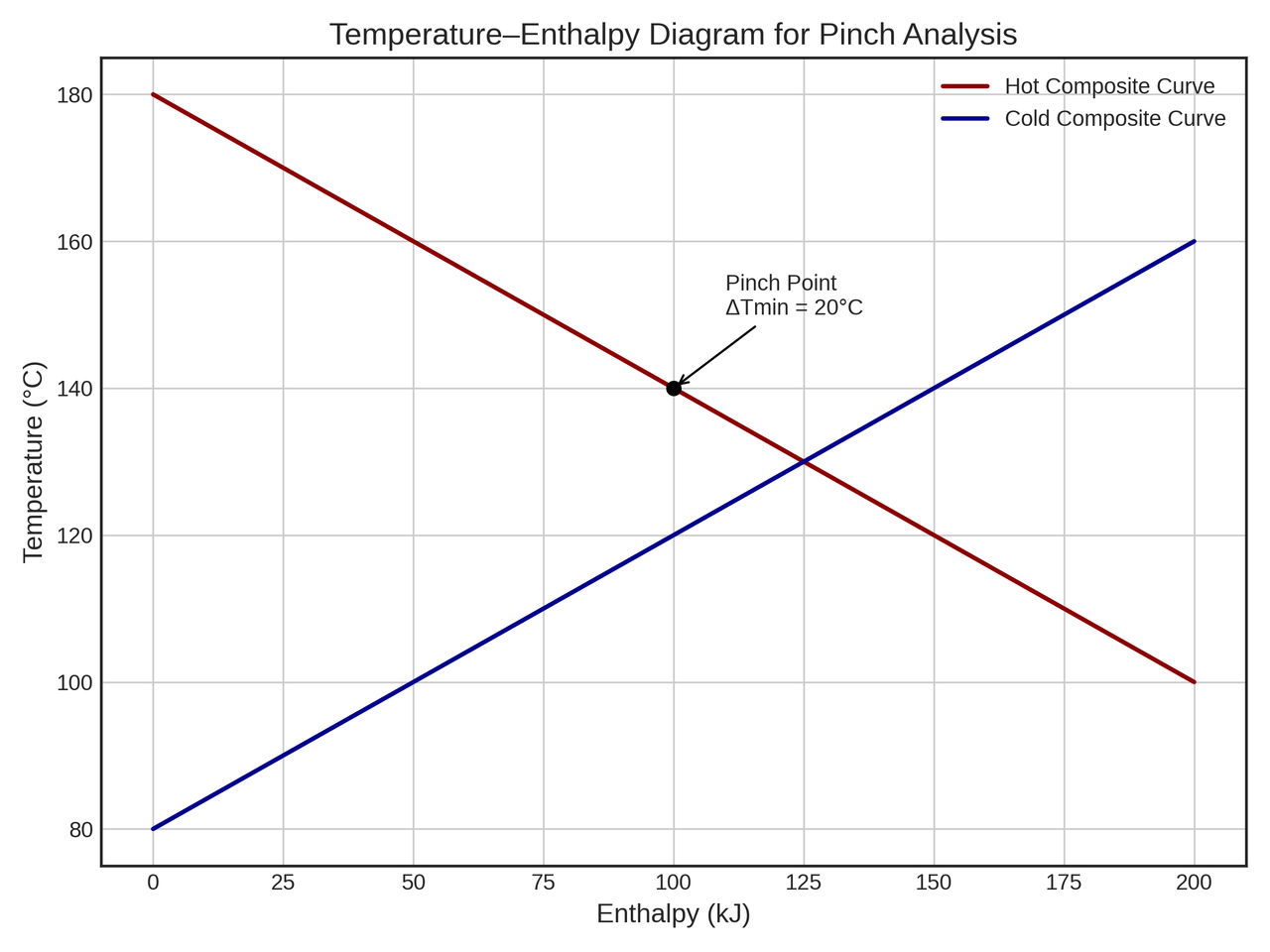
Visual representation of hot and cold streams showing heat recovery potential and the pinch point.
The pinch divides the process into two regions: above the pinch and below the pinch. Above the pinch, the goal is to minimize external cooling and maximize heat recovery. Below the pinch, the goal is to minimize external heating. Design rules then ensure that heat does not cross the pinch, avoiding wasted potential recovery.
How Aspen Plus Supports Heat Integration
Aspen Plus includes built-in capabilities and integration with energy analysis modules that help engineers:
- Automatically identify process hot and cold streams from heaters, coolers, condensers, and reboilers.
- Generate composite curves and grand composite curves directly from the converged simulation.
- Calculate minimum heating and cooling utility targets for a chosen ∆Tmin.
- Propose heat exchanger networks (HENs) that approach these targets while respecting practical constraints.
The advantage is that energy optimization is no longer a separate, manual exercise in spreadsheets. Instead, it becomes an integrated workflow: simulate the process, analyse energy performance, implement heat exchanger changes, and re-simulate to verify performance and operability.
Step-by-Step Workflow: Heat Integration in Aspen Plus
- Build and Converge the Base-Case Flowsheet: Model your process with all key unit operations. Ensure convergence and accurate energy duties.
- Activate Energy Analysis and Define ∆Tmin: Open the energy analysis interface. Specify scope and set the minimum temperature approach (∆Tmin).
- Identify, Review, and Refine Hot and Cold Streams: Verify automatically extracted streams. Exclude irrelevant or unstable streams.
- Generate Composite and Grand Composite Curves: Use these plots to identify pinch points and heat recovery opportunities.
- Set Energy Targets and Evaluate Current Performance: Compare calculated minimum utility targets against your base-case consumption to quantify potential savings.
- Synthesize the Heat Exchanger Network (HEN): Use Aspen’s tools to propose feasible matches. Apply pinch rules (no heat transfer across pinch).
- Implement and Re-Simulate the HEN: Implement the new network back into the flowsheet and re-run to verify convergence and process specs.
- Perform Economic and Sensitivity Analysis: Evaluate CAPEX vs. OPEX to calculate payback and ensure robustness under different scenarios.
Case Study: Heat Integration in a Crude Distillation Unit
Consider a typical refinery crude distillation unit (CDU) where crude feed must be heated from near-ambient temperature to furnace inlet temperature. In a conventional design, much of this heating is provided by a fired heater.
By applying heat integration in Aspen Plus:
- Analysis: Composite curves reveal a large opportunity to preheat cold crude using hot product streams (diesel, kerosene, etc.).
- Implementation: Aspen proposes a preheat train respecting pinch rules.
- Result: Furnace duty drops significantly, fuel consumption decreases, and cooling duty for products is reduced. Published examples often show 20–40% reductions in furnace duty.
Best Practices and Common Pitfalls
Best Practices
- Ensure accurate stream data (temperatures, flow rates, properties).
- Choose realistic ∆Tmin values based on economic trade-offs.
- Keep the flowsheet robust with good initialization strategies.
- Iterate between process and energy design after major changes.
Common Pitfalls
- Overcomplicating the stream list with trivial streams.
- Ignoring non-process constraints like plot space or fouling.
- Pushing ∆Tmin too low, leading to unrealistic area requirements.
- Not validating suggested HENs in the rigorous simulation.
Conclusion: Turning Simulation into Real Energy Savings
Heat integration in Aspen Plus turns your process simulator into a powerful energy optimization platform. By combining pinch analysis, automated HEN synthesis, and rigorous simulation, engineers can systematically reduce utility consumption, enhance sustainability, and create robust, economically attractive designs.