
Aspen HYSYS vs Aspen EDR: Which Is Better for Heat Exchanger Design?
Comparing Aspen HYSYS and Aspen EDR for Heat Exchanger Design
Introduction
Aspen HYSYS and Aspen Exchanger Design & Rating (EDR) are essential software platforms for process engineers working on heat exchanger design and optimization in industries such as oil & gas, petrochemicals, and chemicals. Both tools play distinct but complementary roles in the heat exchanger design workflow, spanning high-level process simulation to detailed equipment-level modeling. This blog provides a comprehensive, technically detailed comparison for advanced engineering practitioners, covering critical workflow integration, technical capabilities, and practical best practices.
The Critical Role of Rigorous Heat Exchanger Design
Heat exchangers are central to process efficiency, energy conservation, and operational flexibility in industrial plants. Rigorous design has a direct impact on capital expenses (CAPEX), operating costs (OPEX), and sustainability—errors or shortcuts can result in oversized equipment, excessive energy loss, operational bottlenecks, or premature failure due to fouling, vibration, or misapplied safety margins. Accurate rating and robust design help reduce risks associated with plant upsets, process inefficiency, and unsafe operating conditions, while allowing for flexible operation and maintenance cycles.
Where Heat Exchanger Design Fits in Process Simulation
In plant engineering, heat exchanger modeling connects upstream process simulation (energy/mass balances, temperature and pressure profiles) with mechanical specification and procurement of equipment. Engineers begin with flowsheets in process simulators (like Aspen HYSYS), sizing exchangers for integration and initial energy targeting. Next, these preliminary designs are refined and rated for detailed geometry, mechanical limits, and safety codes using tools such as Aspen EDR.
Overview of the Tools
Aspen HYSYS
Aspen HYSYS is a steady-state and dynamic process simulation platform. It is widely used for modeling entire plants, focusing on fluid flow, thermodynamics, and complex unit operations. HYSYS excels in early-stage analysis, process integration, what-if studies, and troubleshooting process upsets. Its heat exchanger units support preliminary sizing, duty and temperature prediction, and dynamic simulations.
Aspen Exchanger Design & Rating (EDR)
Aspen EDR is a specialized, mechanistic modeling suite dedicated to heat exchanger design and performance rating. It supports a wide range of exchanger types—shell-and-tube, air-cooled, plate, spiral, condensers, and reboilers—and integrates established HTFS/BJAC methods. EDR performs rigorous thermal, hydraulic, and mechanical analysis, supporting geometric optimization, code compliance (like TEMA), and vibration assessment for exchanger reliability.
Packaging and Integration
Both tools are part of the AspenTech ecosystem. HYSYS is typically included in core process simulation packages, while EDR can be licensed as an integrated module or standalone application for advanced exchanger design and rating.
Core Technical Comparison
Scope and Purpose
| Aspect | Aspen HYSYS | Aspen EDR |
|---|---|---|
| Main Use | Process-level simulation, concept design | Equipment-level design and rating |
| Modeling Focus | Streams, energy/mass balance, integration | Detailed geometry, thermal/hydraulic/mechanical |
| Exchanger Handling | Quick sizing, duty prediction, process link | Geometry optimization, TEMA checks, fouling/vibration analysis |
| Workflow Placement | Concept/Debottlenecking stages | FEED, detailed design, troubleshooting |
Thermodynamics and Correlations
Both tools leverage AspenTech’s proven thermodynamic property methods, including support for electrolyte, non-ideal, and complex phase systems. However, HYSYS is often used for bulk process conditions and basic heat transfer estimation (e.g., overall U values, basic fouling factors), while EDR applies sophisticated, research-based heat transfer and pressure drop correlations—including local film coefficients, phase change, boiling, condensation, and proprietary algorithms for specialized scenarios. EDR’s geometry-level detail enhances the accuracy of predicted performance by considering factors like verified shell/tube layouts, actual baffle configurations, and mechanical constraints.
Design vs. Rating Workflow
The typical workflow involves:
- Developing a converged HYSYS process model (streams, duties, T–Q curves).
- Exporting HYSYS exchanger blocks to EDR for detailed rating (via export/import or live-link integration).
- In EDR, specifying or optimizing geometry, tube layouts, baffle types, passes, and verifying operation against codes (e.g., TEMA, ASME).
- Iterating between process and equipment design for optimal performance.
Simulation-level exchangers in HYSYS provide area/duty estimation, while equipment-level exchangers in EDR check mechanical integrity, optimize configurations, and provide detailed cost and operability data.
Types of Exchangers and Services
Both suites support Shell-and-tube (types E, F, G, Kettle, U-tube), Air-cooled, Plate, and Spiral exchangers, as well as specialized services like condensers and reboilers. EDR provides deeper support for advanced configurations—multi-zone, non-Newtonian, two-phase, double-banking, and non-standard geometries.
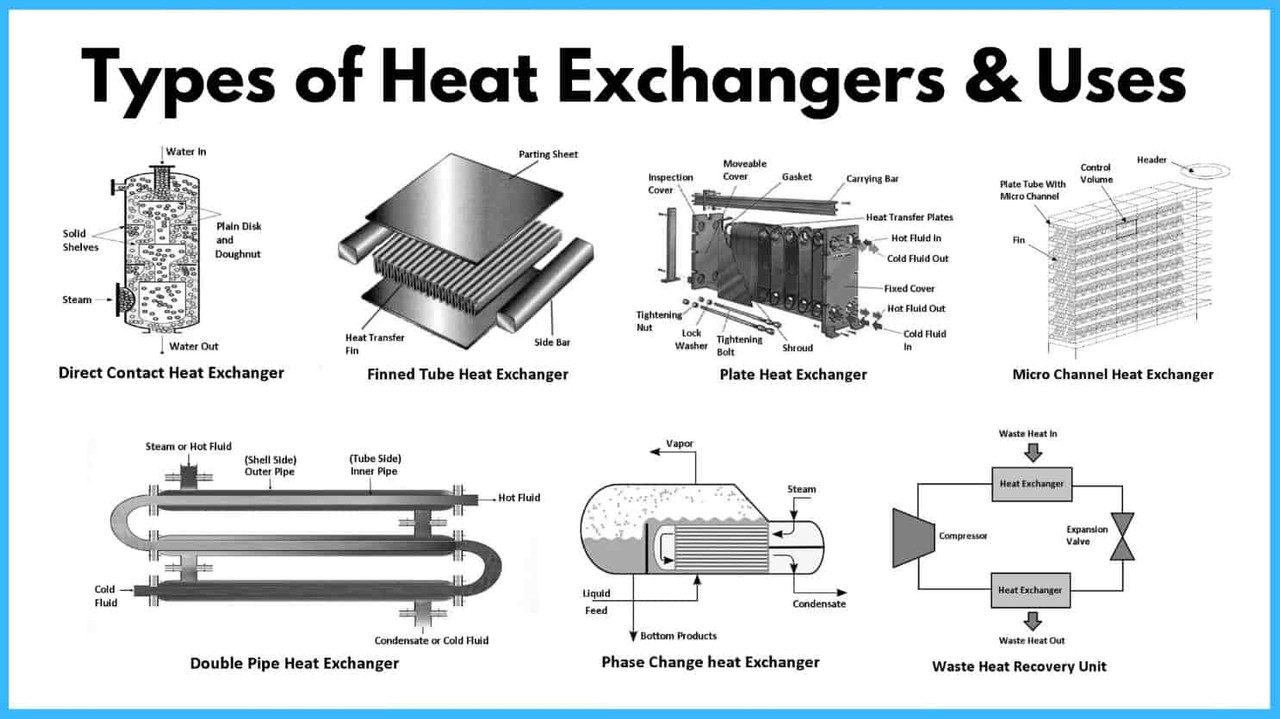
Overview of various heat exchanger configurations including Shell & Tube, Plate, and specialized designs.
Fouling, Vibration & Mechanical Checks
HYSYS uses simple “fouling factors,” typically at the process integration level. EDR conducts detailed fouling analysis for both sides, predicts vibration risk, checks tube support/spacing, allowable velocities, and pressure drops, and enforces TEMA-based mechanical standards. This helps prevent field failures and ensures code compliance.
Integration and Data Transfer
HYSYS–EDR integration streamlines design:
- Use “live-link” or file-based workflows to export process conditions from HYSYS block directly to EDR (composition, temperature, pressure, duty, area).
- EDR model geometry is iteratively refined, feeding calculated area, pressure drops, and geometry back into HYSYS.
- Changes in process conditions or exchanger configuration can automatically update simulation and equipment models, reducing manual data entry and error risk.
Typical Use Cases and Best Practices
- Use HYSYS Alone: Screening and concept studies—rough exchanger count/areas; Basic process debottlenecking.
- Use HYSYS + EDR: Front-end engineering design (FEED), detailed design, and procurement; Revamping/retrofitting existing exchangers; Troubleshooting performance issues; Evaluating high-risk or specialized scenarios.
Case Study Outlines
- Revamping an Existing Shell-and-Tube Exchanger: After identifying a bottleneck in HYSYS, export conditions to EDR for detailed rating. Evaluate new tube layouts, baffle changes, and TEMA compliance for increased throughput.
- Designing a Distillation Column Overhead Condenser: Simulate vapor loading in HYSYS, export to EDR for optimal geometry selection (surface area, condenser configuration), check vibration/safety limits, and select materials for longevity.
- Troubleshooting Air Cooler Bottleneck: Use HYSYS for process-side assessment; move data to EDR for mechanical checks—evaluate fan performance, optimal tube layout, and verify vibration and noise criteria for gas processing.
Advantages and Limitations
| Tool | Strengths | Limitations |
|---|---|---|
| Aspen HYSYS | Fast process integration, easy scenario/change | Limited mechanical detail, basic fouling/vibration models |
| Aspen EDR | High-fidelity thermal/mechanical calculations | Requires more inputs, niche expertise, longer setup |
HYSYS is effective for quick process studies but risks poor geometry selection if used in isolation. EDR ensures robust, validated equipment design but can be less suited to early-stage studies without defined process conditions.
Common Skill Requirements and Pitfalls
Both tools demand a rigorous understanding of thermodynamics, property method consistency, and TEMA/ASME codes. Users often err by relying on “default” settings (e.g., fouling factors, phase assumptions), or by failing to iterate geometry optimization as process loads change. Avoid mis-specification of phase behavior, and always validate default property method selections.
Practical Guidance and Recommendations
Decision Flow-Logic
- If you need heat duty/area only → Use HYSYS
- If you need geometry, mechanical checks, or equipment rating → Move to EDR
- If process changes require reevaluation of equipment → Iterate between HYSYS and EDR
Tips for Effective Use
- Always use consistent thermodynamic property methods across both tools to avoid data drift.
- Transfer converged stream conditions only; avoid exporting unstable or non-representative results.
- Validate fouling and design margins with realistic process data, not just defaults.
- Document all geometry choices, baffle layouts, and configuration changes for review.
- Regularly iterate between process and equipment design—update models when process loads or configurations change.
- Use EDR’s automated code compliance and vibration analysis features for high-risk and critical services.
- Train team members in both process and mechanical domains to bridge the data and communication gap across disciplines.
Conclusion
Aspen HYSYS and Aspen EDR are best used together for robust heat exchanger design—HYSYS for process integration and rapid “what-if” analysis, EDR for equipment-level validation, optimization, and mechanical/code compliance. Like two halves of the design equation, these tools deliver reliability, efficiency, and safety only when thoughtfully integrated into the engineering workflow.