
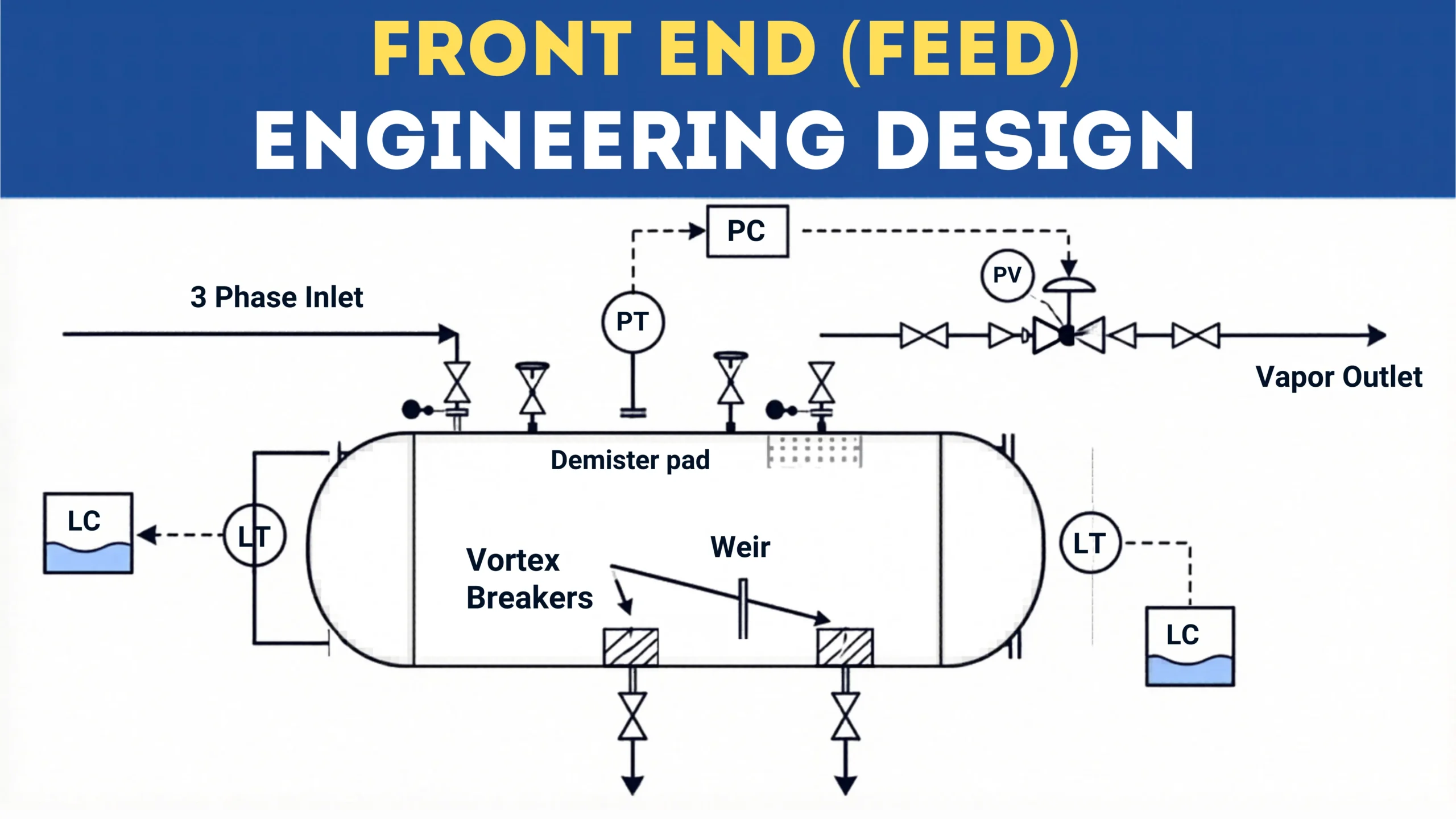
FEED Engineering: Shaping Your Project Outcomes
FEED Engineering: The Phase That Shapes Project Success
Why decisions made during the 1–3% of project cost dictate 80% of its final outcome.
What FEED Actually Is
FEED is the engineering phase that converts a business objective into a technically defined project. It covers process design, equipment sizing, safety philosophy, utility systems, plot layout, cost estimation, and procurement strategy — all before detailed engineering begins.
Every downstream decision in an EPC (Engineering, Procurement, and Construction) project traces back to something decided during FEED.
The Number That Changes How You See FEED
FEED typically costs a tiny fraction of the overall capital expenditure, but its leverage is enormous.
That gap is why poor FEED preparation is one of the most expensive mistakes in capital project execution — and why cutting FEED short to save time almost always costs exponentially more later.
What FEED Failure Actually Looks Like
FEED failures rarely look like failures at the time. They look like reasonable shortcuts under intense schedule pressure:
- Skipping simulation validation to save weeks → leads to months of troubleshooting unstable operations after startup.
- Freezing plot layout without a maintenance access review → leads to expensive structural dismantling to replace equipment later.
- Accepting vendor pump data without hydraulics checks → leads to misaligned selections that underperform in real system conditions.
- Treating HAZOP as a documentation step → leads to relief system inadequacies discovered during early operations.
Each of these felt like progress during planning. Each became a massive cost problem at a more expensive stage.
Owner FEED vs. Contractor FEED — A Distinction That Matters
When the EPC contractor manages FEED, the scope tends to be defined to protect execution, not to optimize operations.
The contractor’s priority is deliverability. The owner’s priority is long-term performance. These are not always the same thing. Owners who engage independent technical reviews during FEED — before scope is frozen — consistently report better alignment between design intent and operational reality.
Where FEED Quality Is Won or Lost
Process Simulation
Simulations built only for design-point conditions look accurate on paper but struggle when feed quality shifts or throughput varies. Strong FEED simulation stress-tests off-design and turndown scenarios — not just the ideal operating case.
Process Safety
Safety studies conducted after P&IDs are finalized result in late corrections — pipe rerouting, extra relief devices, and revised control logic. Safety review that runs parallel to process development eliminates most of that rework before it starts.
Utility and Hydraulics
Utility systems sized strictly for Day 1 throughput become bottlenecks when production targets increase — which they almost always do. Designing for operational flexibility during FEED costs very little. Retrofitting for it during operations is incredibly expensive and disruptive.
Equipment and Plot Layout
Plot plans approved quickly tend to optimize for construction convenience, not operational logic. But remember: Operators and maintenance teams have to live with those layout decisions for the next 20 to 30 years.
What Separates Strong FEED from Average FEED
The difference is not a fancy new methodology. It is simply time, discipline, and technical seriousness applied early in the project lifecycle.

The impact of early planning and technical discipline on project success.
The Financial Reality
Industry data on large capital projects consistently shows:
- Projects with mature FEED packages at EPC contract award have significantly lower cost growth and schedule slippage.
- Compressed FEED regularly produces cost overruns of 15–40% above sanction estimates.
- A high proportion of major EPC change orders trace directly back to scope gaps in the FEED package.
Money saved by rushing FEED does not disappear. It reappears — multiplied — during execution.
Two Trends Reshaping FEED Today
- Digital Twins: Leading organizations now build simulation models during FEED that continue into operations as live digital twins. The FEED investment becomes a long-term operational asset, not just a one-time deliverable.
- Decarbonization: Energy and emissions targets are now influencing equipment selection, heat integration, and utility design — decisions that must be resolved during FEED. Projects that treat carbon performance as a post-FEED consideration routinely require expensive rework.
Conclusion
FEED is not a documentation exercise before real engineering begins. It is where the project’s cost, safety, and operational performance are fundamentally set.
Organizations that treat FEED as a technical investment — rather than a schedule obligation — build facilities that perform closer to design intent, cost less to correct, and operate more safely over their full lifecycle.
🎯 ChemKlub Consulting: Process Simulations & Software Consultancy
We provide FEED engineering support, advanced process simulation, and process safety consulting for industrial clients across Oil & Gas, Refining, Petrochemicals, and Specialty Chemicals.
Ensure your project’s foundation is built on rigorous engineering, not optimistic assumptions.
👉 Explore ChemKlub FEED Engineering Services