
Impact of Heat Duty on Heat Exchanger Efficiency
Effect of Heat Duty on Heat Exchanger Performance
Understanding how heat duty impacts heat exchanger performance is vital for engineers, plant operators, and anyone involved in industrial or commercial process optimization. Modern industries—from chemical manufacturing to power generation—rely on efficient heat exchanger operation to maximize energy savings and maintain reliable system performance.
What is Heat Duty? The Foundation of Heat Exchanger Performance
Heat duty, a core performance measure, is the total amount of heat energy a heat exchanger must transfer per unit time to achieve the targeted temperature change in process fluids. Properly calculating heat duty ensures the heat exchanger is sized and operated to meet process requirements, prevent bottlenecks, and avoid costly overdesigns.
Heat Duty Formula and Real-World Significance
For sensible heat transfer (no phase change):
Q = M × Cp × ΔT
where:
Q = heat duty (W or kW)
M = mass flow rate (kg/s)
Cp = specific heat (kJ/kg·K)
ΔT = temperature change (°C or K)
For phase change processes:
Q = M × λ
where λ is the fluid’s latent heat of vaporization or condensation. Correct calculation is essential during the design stage and for daily plant operation to achieve maximum efficiency and avoid system upsets.

Shows the relationship between temperature difference and heat exchange length.
How Heat Duty Influences Efficiency and Reliability
Impact on Different Heat Exchanger Types
- Shell-and-Tube Heat Exchangers: Higher heat duty demands larger surface areas (longer or more tubes) to ensure effective transfer and may require multi-pass arrangements.
- Plate Heat Exchangers: Increased heat duty may be addressed by adding more plates or optimizing plate design for turbulence and higher flow rates.
- Air-Cooled and Compact Exchangers: Heat duty affects fan power requirements, material selection, and cooling fin design.
If a heat exchanger operates far below or above its design heat duty, efficiency drops—either failing to deliver the target temperatures or consuming more energy than necessary.
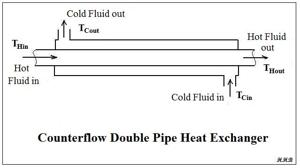
Schematic showing fluid inlets and outlets in a counterflow arrangement.
Effects of Unmatched Heat Duty
- Overloading can generate excess pressure drop, enhance fouling, and reduce the lifespan of the equipment.
- Underloading leads to poor heat recovery, wasted capacity, and sub-optimal operational economics.
Factors Shaping Achievable Heat Duty
Temperature Difference (ΔT)
Heat transfer depends on the temperature difference between hot and cold fluid streams—larger differentials boost heat duty, while narrow approaches (targeting very close inlet/outlet temperatures) may need vastly larger exchangers and raise costs.
Fluid Properties
The mass flow rate and specific heat of process fluids directly determine the heat duty a heat exchanger must handle. Viscous or poorly conducting fluids need larger surface areas or special designs.
Fouling Considerations
Fouling—buildup of contaminants on heat transfer surfaces—reduces thermal conductivity and effective area, thus limiting the heat exchanger’s ability to meet its designated heat duty. This can result in unplanned shutdowns or persistent energy loss, making preventive maintenance and monitoring essential.
Practical Scenarios: Heat Duty and Heat Exchanger Design
Increased Heat Duty in Practice
Suppose a plate heat exchanger in a food processing plant must handle a new product stream with higher flow and target temperature. The new heat duty calculation may require installing extra plates, tweaking flow arrangements, or even adding a parallel unit to avoid process bottlenecks and meet energy needs.
Decreased Heat Duty Situations
If production drops, a heat exchanger may run well below its design load. This can lead to lower outlet temperatures and energy waste, or problems like condensation and corrosion in air-cooled units.
Sizing and Surface Area Calculations
Heat exchangers are sized so their design heat duty matches actual process demand, factoring in safety margins for fouling, process spikes, and maintenance intervals. Oversizing is avoided as it raises costs, while undersizing limits throughput and reliability.
Example in Industrial Water Heating
Heating 5,000 kg/h of water from 30°C to 80°C:
Q = 5000 × 4.18 × (80 − 30) = 1,045,000 kJ/h ≈ 290 kW
A phase change scenario (e.g., condensing 2,000 kg/h steam at 2257 kJ/kg):
Q = 2000 × 2257 = 4,514,000 kJ/h ≈ 1,254 kW
Optimization: Best Practices for Monitoring and Control
To maximize operational performance and energy efficiency, engineers and operators should:
- Continuously monitor temperature, pressure, and flow at inlets and outlets to rapidly identify deviations from design heat duty.
- Install distributed sensors for real-time diagnostics on fluid distribution, fouling, and system performance.
- Schedule regular maintenance to remove fouling and restore surface area, maintaining peak heat duty.
- Adjust flow rates and system configurations as process requirements shift, preventing inefficiencies or hardware damage.
The Role of Heat Duty in Energy Efficiency and Sustainability
Efficient management of heat duty is key for any site focused on energy savings, greenhouse gas reduction, and process uptime. By optimizing heat duty, plants reduce wasted energy, lower operational costs, and extend equipment lifespan—delivering clear advantages in competitive industries.
Conclusion
A precise grasp of heat duty—its calculation, its dynamic effects, and the physical factors that influence it—is crucial to designing, operating, and maintaining high-performing, energy-efficient heat exchangers. By applying these principles, industries can achieve consistent product quality, enhanced sustainability, and a strong bottom line in their thermal processes.